
Military & Veteran Counseling
in Colorado Springs
For active-duty service members and veterans who are strong, capable—and carrying more than they want to carry alone.
You’re capable. That doesn’t mean you have to carry everything alone.
Military life asks a lot of you. You learn to perform under pressure. You learn to accomplish the mission regardless of how you feel. You adapt, compartmentalize, keep moving, and take care of the people around you. Those are strengths.
But sometimes the very things that help you succeed in the military can make it difficult to recognize when something isn’t working—or to ask for help when you need it. You may be doing your job well and still struggling underneath.
You may be carrying experiences that you haven’t really dealt with. You may notice that you’re more angry, anxious, numb, or on edge than you used to be. Maybe you aren’t sleeping. Maybe your relationships are suffering. Maybe you’re drinking more, isolating, using pornography, or finding other ways to shut your brain off when the day is over. Or maybe you’re simply tired of carrying everything yourself.
I get it.
Getting help doesn’t mean you aren’t strong or capable. Sometimes it’s what allows you to keep being both.
Counseling from someone who understands military culture
Before becoming a counselor, I served as an Air Force pilot. That matters to the way I approach counseling with active-duty service members and veterans.
I understand something of the culture you come from—the mission focus, responsibility, expectations, dark humor, relationships, deployments, moves, uncertainty, and the pressure to keep performing even when life is difficult.
You shouldn’t have to spend half of a counseling session explaining military culture before you can explain what’s actually happening to you. And I’m not approaching you from the assumption that because you’re struggling, something is wrong with you.
Military members are often extraordinarily strong and capable people. Strong and capable people can also get hurt.
PTSD and trauma don’t always look the way you expect
When people hear PTSD, they often imagine someone whose life has completely fallen apart. That isn’t always what trauma looks like.
You can have PTSD and still go to work. You can lead people, accomplish the mission, raise your children, work out, maintain friendships, and appear completely functional to everyone around you. Meanwhile, your nervous system may be working overtime.
Trauma can show up as:
- Being constantly alert or unable to relax
- Irritability or anger
- Difficulty sleeping
- Nightmares or intrusive memories
- Anxiety or panic
- Emotional numbness
- Avoiding certain places, people, conversations, or memories
- Feeling disconnected from your spouse or family
- Difficulty trusting people
- Drinking or using other behaviors to shut things down
- Feeling like you always need to be doing something
- Guilt or shame about things that happened
- Feeling different from the person you were before
Sometimes you know exactly where those reactions came from. Sometimes you don’t. Part of trauma therapy is figuring that out.
Why Veterans and Military Counseling?
Trauma recovery isn’t about making you weaker
Some service members worry that counseling means sitting in a room endlessly talking about feelings or digging into memories they’d rather leave alone. That’s not my goal.
I want to understand what happened to you, how your mind and body adapted to it, and whether those adaptations are still serving you. Because your brain is remarkably good at learning how to survive.
If you’ve spent enough time in dangerous, unpredictable, or high-pressure environments, your brain learns to respond accordingly. It becomes faster at detecting threats. It learns what to pay attention to, what to shut down, and how to keep you functioning.
The problem comes when those responses follow you somewhere they’re no longer needed.
The hypervigilance that kept you safe downrange can make it difficult to relax at home.
The ability to compartmentalize can help you accomplish a mission but leave your spouse wondering why you won’t let them in. Anger can help you mobilize quickly but become destructive when your nervous system treats ordinary conflict like a threat. And the ability to push through almost anything can keep you from realizing just how exhausted you’ve become.
Trauma therapy isn’t about taking those strengths away. It’s about helping your brain recognize when it no longer has to fight the same battle.
Getting help can make you better at your mission
There can be a powerful message in military culture that asking for help means you couldn’t handle something yourself. I don’t believe that.
Getting help is often an incredibly practical decision. If something is interfering with your sleep, concentration, relationships, judgment, emotional control, or ability to be present, ignoring it doesn’t make you tougher. It just gives the problem more time to grow.
Counseling gives you a place to deal with those things deliberately.
For someone who is still serving, that can mean becoming more effective in your work and more present when you go home.
For a veteran, the mission may have changed. The work may involve figuring out how to carry the strengths you developed in the military into civilian life without remaining trapped in patterns you no longer need.
Either way, the goal isn’t simply to reduce symptoms.
The goal is greater freedom.
Freedom to sleep. Freedom to relax without constantly scanning the room. Freedom to be present with your spouse and children. Freedom from memories or experiences that continue to dictate how you live. And freedom to put your strength toward the things that matter to you now.
Counseling for active-duty military members
Seeking counseling while you’re serving can come with additional concerns.
You may wonder what it means for your career. You may worry about how others will perceive you. You may be accustomed to being the person other people depend on and uncomfortable being the one who needs something. Those concerns are worth talking about openly.
My goal isn’t to convince you that military life shouldn’t affect you. It does. The goal is to help you deal with those effects in a way that allows you to continue functioning well in the areas of life that matter to you.
Counseling for veterans
Leaving the military doesn’t necessarily mean leaving military life behind.
For some veterans, the transition is relatively smooth. For others, it raises questions they didn’t expect. Who am I without the mission? Where do I belong? Why does civilian life feel so frustrating? Why do I miss something that I also couldn’t wait to leave?
And for some, experiences that could be compartmentalized while serving become harder to ignore once life slows down.
Counseling can provide a place to make sense of those experiences, work through trauma when necessary, and determine what you want the next part of your life to look like.
Your military service will always be part of your story. It doesn’t have to control the rest of it.
Christian counseling for military / veterans
For some service members and veterans, trauma also raises questions about God, morality, suffering, guilt, forgiveness, and meaning. Those questions don’t always fit neatly into a PTSD checklist.
I hold a Master of Divinity in addition to my counseling training, and I’m comfortable integrating Christian faith and theology into our work when that’s something you want.
That can include wrestling honestly with difficult experiences rather than using faith to avoid them.
You don’t have to pretend everything makes sense.
Costs and Next Steps
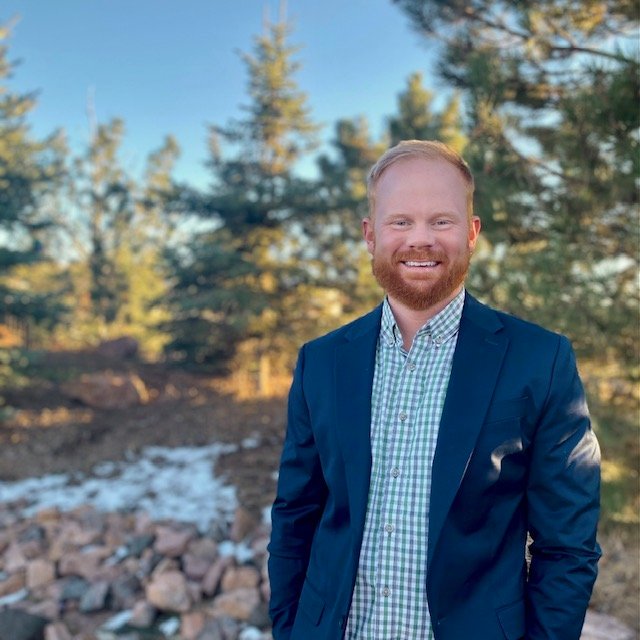
I’m Austin Hendrickson, a Licensed Professional Counselor and former Air Force pilot providing counseling for active-duty military members and veterans in Colorado Springs.
I work particularly with PTSD, trauma, relationship difficulties, and the ways military experiences can continue affecting life long after the immediate situation has passed.
Counseling is available in person in Colorado Springs and by telehealth throughout Colorado and Virginia. Individual counseling sessions are $135 for 50 minutes. I accept TRICARE and Aetna and also offer self-pay and out-of-network options.
You don’t need to know exactly what you need before reaching out.
Schedule a free 15-minute consultation
You don’t need to know exactly what you need before reaching out.
We’ll talk about what’s going on, what you want to change, and whether working together makes sense.

Frequently Asked Questions
A: My background as an Air Force Academy graduate, military aviator, and Air Force officer gives me personal familiarity with military training, culture, service, and transition. But every person’s experience is different, and I will not assume that my story is yours.
A: Yes, and this feeling is a common one. You can use the free consultation to describe what you are experiencing, ask questions, and determine whether my experience and practice are a good fit for your needs.
A: Yes. I work with military spouses, couples, and families as well as individuals. During the consultation, we can discuss what format may best fit your concerns and goals.
A: Yes. I accept Tricare and Aetna insurance. Please confirm your individual coverage and benefits with your insurer.
A: Yes. I offer telehealth for clients located in Colorado and Virginia, where I am licensed, as well as in-person counseling in Colorado Springs.
A: If you are in immediate danger, call 911. For emotional distress or a mental health crisis, call or text 988. Veterans and service members may call 988 and press 1. My website forms and email are not continuously monitored.